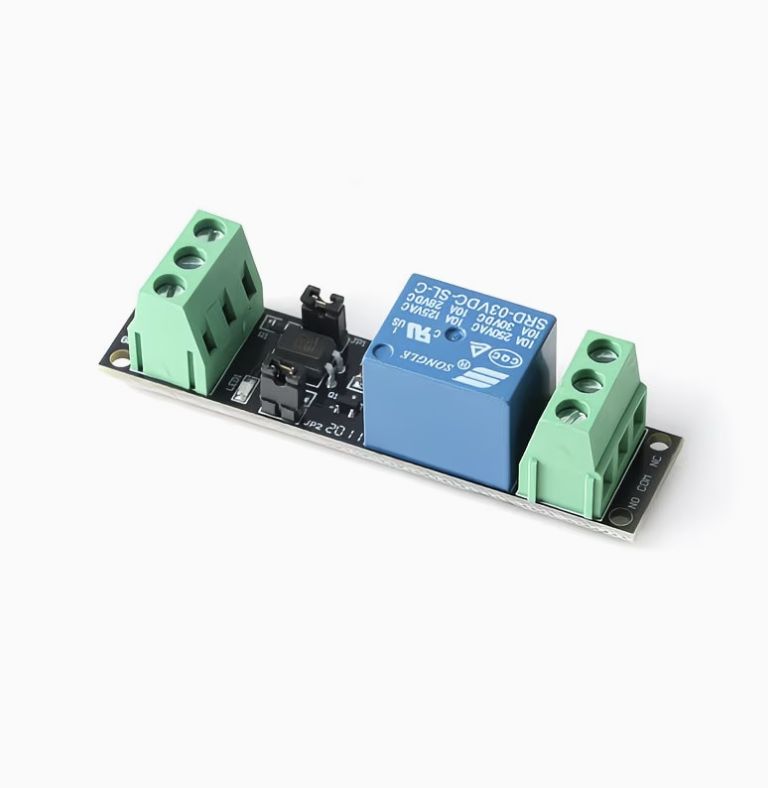
1-Channel 3.3V Relay Module with Optocoupler Isolation
Share
R77.39
Buy and save
Buy and earn R0.44 Loyalty for your next purchase
Loyalty is a discount program that lets you buy products and earn points to redeem on your next purchase. Your Loyalty balance is updated when you pay online or in-store. The Loyalty amount shown on this page can be recalculated at the checkout.
In stock
1
1-Channel 3.3V Relay Module with Optocoupler Isolation
Share
Product Details
1-Channel 3.3V Relay Module with Optocoupler Isolation – Technical Specifications:
| Module Type | – Single Channel High-Level Trigger Relay Module |
| Control Voltage | – 3.3V (High-Level Trigger) |
| Compatible Logic | – 3.3V (ESP8266, ESP32, STM32, Raspberry Pi) |
| Relay Rating (AC) | – 250V AC / 10A |
| Relay Rating (DC) | – 30V DC / 10A |
| Relay Type | – SPDT (Single Pole Double Throw) |
| Relay Contacts | – NO (Normally Open), NC (Normally Closed), COM (Common) |
| Isolation | – Optocoupler Isolated (Control Circuit ↔ Load Circuit) |
| Trigger Type | – High-Level Trigger (Activates on Logic HIGH / 3.3V) |
| Coil Voltage | – 3V / 3.3V DC |
| Indicator LED | – Onboard Status LED (ON when Relay Activated) |
| Control Interface | – 3-Pin Header (VCC, GND, IN) |
| PCB Dimensions | – 44 × 17mm (approx.) |
| Operating Temperature | – -25°C to +70°C |
| Compatible Platforms | – ESP8266, ESP32, ESP32-C3, STM32, Raspberry Pi |
Handy Tips for Using the 3.3V Optocoupler Relay Module:
1: This module is specifically designed for 3.3V microcontrollers such as the ESP8266, ESP32, and Raspberry Pi. Standard 5V relay modules require a 5V HIGH signal to trigger reliably — this module is built around a 3.3V coil and high-level trigger logic, meaning it activates when your microcontroller outputs a standard 3.3V HIGH signal from any GPIO pin. No level shifting or additional components are required.
2: The optocoupler isolation is a critical safety feature — it electrically separates the low-voltage control circuit (your microcontroller) from the high-voltage load circuit (the relay and whatever it is switching). This means spikes, surges, or faults on the mains-voltage side cannot travel back through the control line and damage your ESP8266 or ESP32. Always use optocoupler-isolated relay modules when switching mains voltage loads.
3: The relay is SPDT (Single Pole Double Throw) — it has three load terminals: COM (Common), NO (Normally Open), and NC (Normally Closed). When the relay is not activated, COM is connected to NC. When the relay is activated (GPIO HIGH), COM switches to NO. For most switching applications (turning a device ON when triggered), connect your load between COM and NO.
4: This is a high-level trigger module — the relay activates when the IN pin receives a HIGH (3.3V) signal and deactivates when it receives a LOW (0V) signal. This is the opposite behaviour to many common 5V relay modules which are active LOW. In your Arduino or MicroPython code, digitalWrite(PIN, HIGH) or pin.value(1) turns the relay ON, and digitalWrite(PIN, LOW) or pin.value(0) turns it OFF.
5: Although the relay contacts are rated for 10A / 250V AC, always apply a safety derating of 20–30% for continuous or resistive loads — keeping sustained loads below 7–8A is recommended for long-term reliability. For inductive loads such as motors, pumps, or compressors, derate further to around 5A, and always fit a snubber circuit (100Ω resistor + 0.1µF capacitor in series) across the relay contacts to suppress the voltage spikes that inductive loads generate when switched off.
Display prices in:ZAR