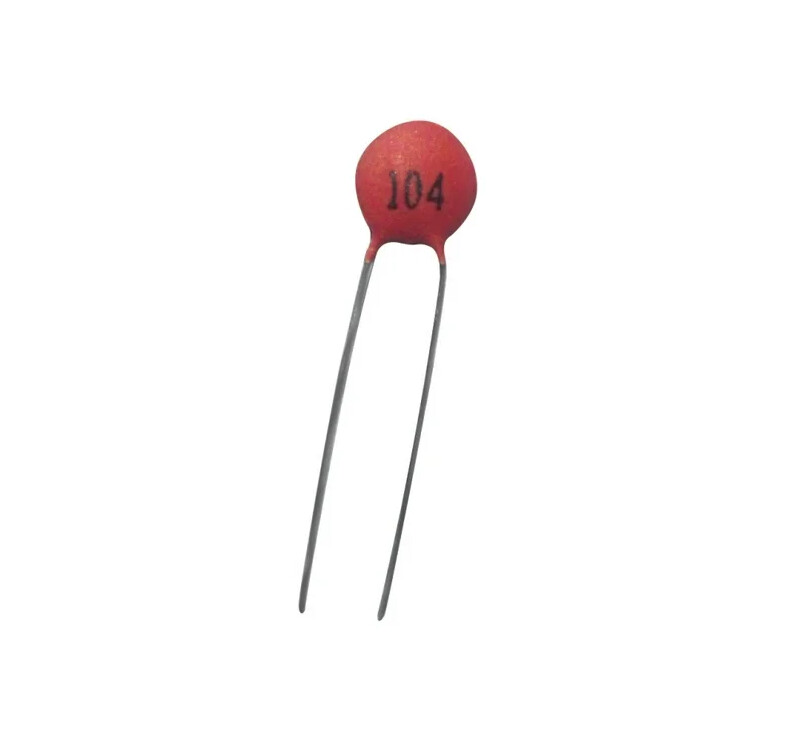
104 Ceramic Capacitor (5 Pack)
R10.00
Price incl. VAT (15%) R1.30
Buy and save
Buy and earn R0.05 Loyalty for your next purchase
Loyalty is a discount program that lets you buy products and earn points to redeem on your next purchase. Your Loyalty balance is updated when you pay online or in-store. The Loyalty amount shown on this page can be recalculated at the checkout.
In stock
1
Save this product for later
104 Ceramic Capacitor (5 Pack)
Product Details
-
104 Ceramic Capacitor 100nF (0.1µF) – 5 Pack – Technical Specifications:
Capacitance Code – 104 (10 × 10⁴ pF = 100,000pF = 100nF = 0.1µF) Capacitance Value – 100nF (0.1µF) Capacitor Type – Multilayer Ceramic Capacitor (MLCC) Voltage Rating – 50V DC Tolerance – ±10% (K) Temperature Coefficient – Y5V / Z5U (General Purpose) Package Style – Radial Through-Hole (Disc) Lead Pitch – 2.54mm (Standard 0.1" / 100mil) Operating Temperature – -25°C to +85°C Quantity – 5 Pieces per Pack Compatible Platforms – Arduino, ESP8266, ESP32, Raspberry Pi, Breadboards, PCBs
Handy Tips for Using the 104 Ceramic Capacitor (100nF / 0.1µF):
1: The code "104" is a standard capacitor marking, not a part number. It is read as: the first two digits (10) are the significant figures, and the third digit (4) is the multiplier — meaning 10 × 10⁴ picofarads = 100,000pF = 100nF = 0.1µF. All three values mean exactly the same thing and you will see all three used interchangeably on datasheets and in tutorials.
2: The 100nF ceramic capacitor is one of the most widely used components in electronics and is found in almost every circuit. Its primary role is as a decoupling or bypass capacitor — placed between the VCC and GND pins of ICs and microcontrollers to filter out high-frequency noise and voltage spikes on the power supply line. As a rule of thumb, place one 100nF capacitor as close as possible to the power pin of every IC in your circuit.
3: Unlike electrolytic capacitors, ceramic capacitors are non-polarised — they have no positive or negative leg and can be inserted into a circuit in either orientation without risk of damage. This makes them very beginner-friendly and quick to use on a breadboard.
4: The 50V voltage rating means the capacitor can safely handle up to 50V DC across its terminals. For typical 3.3V and 5V microcontroller projects this provides a large safety margin. Always ensure the voltage rating of any capacitor exceeds the maximum voltage it will experience in your circuit.
5: Ceramic capacitors have very low ESR (Equivalent Series Resistance) and are excellent at filtering high-frequency noise — making them the preferred choice for decoupling, signal filtering, and timing circuits. For bulk energy storage or low-frequency filtering (such as smoothing a rectified power supply), an electrolytic capacitor with a much higher capacitance value is more appropriate.
Display prices in:ZAR