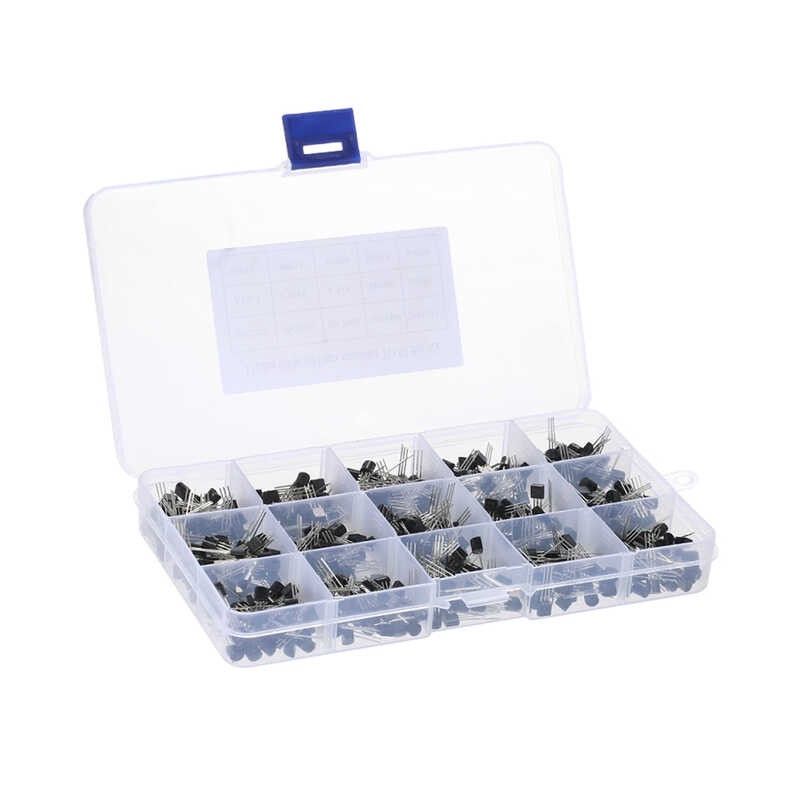
600-Piece TO-92 Transistor Assortment Kit – 15 Values NPN & PNP, 2N2222 to S9018
Share
R312.17
Buy and save
Buy and earn R1.79 Loyalty for your next purchase
Loyalty is a discount program that lets you buy products and earn points to redeem on your next purchase. Your Loyalty balance is updated when you pay online or in-store. The Loyalty amount shown on this page can be recalculated at the checkout.
In stock
1
600-Piece TO-92 Transistor Assortment Kit – 15 Values NPN & PNP, 2N2222 to S9018
Share
Product details
600-Piece TO-92 Transistor Assortment Kit – Contents:
| Transistor | Type | Vceo | Ic Max | Quantity |
|---|---|---|---|---|
| 2N2222 | NPN | 40V | 600mA | 40pcs |
| 2N3904 | NPN | 40V | 200mA | 40pcs |
| 2N5551 | NPN | 160V | 600mA | 40pcs |
| C945 (2SC945) | NPN | 50V | 150mA | 40pcs |
| C1815 | NPN | 50V | 150mA | 40pcs |
| S8050 | NPN | 40V | 500mA | 40pcs |
| S9013 | NPN | 40V | 500mA | 40pcs |
| S9014 | NPN | 50V | 100mA | 40pcs |
| S9018 | NPN | 30V | 50mA | 40pcs |
| 2N3906 | PNP | 40V | 200mA | 40pcs |
| 2N5401 | PNP | 150V | 600mA | 40pcs |
| A1015 | PNP | 50V | 150mA | 40pcs |
| S8550 | PNP | 40V | 500mA | 40pcs |
| S9012 | PNP | 40V | 500mA | 40pcs |
| S9015 | PNP | 50V | 150mA | 40pcs |
| Total | 9× NPN / 6× PNP | – | – | 600pcs |
Technical Specifications:
| Package Type | – TO-92 Through-Hole (All Values) |
| Voltage Range | – 30V to 160V (Vceo, varies by type) |
| Current Range | – 50mA to 600mA (Ic, varies by type) |
| Power Dissipation | – 250mW to 625mW (varies by type) |
| Pin Pitch | – 2.54mm (Standard 0.1" / 100mil) |
| Compatible Platforms | – Arduino, ESP8266, ESP32, Raspberry Pi, Breadboards, PCBs |
| Storage | – Labelled Compartment Box Included |
Handy Tips for Using the TO-92 Transistor Assortment Kit:
1: This kit contains both NPN and PNP transistors — understanding the difference is the most important first step. NPN transistors (2N2222, 2N3904, S8050 etc.) switch current to GND — the load connects between VCC and the Collector, and the GPIO drives the Base through a resistor to turn it on. PNP transistors (2N3906, A1015, S8550 etc.) are the complement — they switch current from VCC and are used for high-side switching where the load sits between the Emitter and GND.
2: The TO-92 pinout varies between manufacturers and transistor families — do not assume all transistors in the box share the same pin order. Always look up the specific datasheet for each transistor type before wiring. Use a component tester (available for under R100) to instantly identify NPN vs PNP, display hFE gain, and correctly identify the Emitter, Base, and Collector pins of any unknown transistor in seconds.
3: The 2N2222 and S8050 are the workhorses for general switching; the S9018 is optimised for high-frequency RF circuits up to 600MHz; the 2N5551 and 2N5401 handle higher voltage applications up to 160V; and the S9013 and S9012 are well suited to audio amplification circuits. Having all 15 values on hand covers virtually every common small-signal transistor application.
4: Always use a Base resistor between your GPIO pin and the transistor Base — never connect directly. For 5V GPIO (Arduino), a 1kΩ resistor is a safe starting value. For 3.3V GPIO (ESP8266, ESP32), use 330Ω to 470Ω to ensure sufficient base drive current to fully saturate the transistor into its switching region. An under-driven transistor operates in its linear region, wasting power as heat instead of switching cleanly.
5: When switching inductive loads such as relay coils, solenoids, or small motors, always place a flyback diode (such as a 1N4007) across the load in reverse bias — cathode to VCC, anode to Collector. Without this, the voltage spike from a collapsing magnetic field when the transistor switches off can instantly destroy the transistor even at low currents.
6: Keep the compartment box closed when not in use — transistors that get mixed between compartments are very difficult to identify by eye alone, as many TO-92 packages look identical. If mixing occurs, a cheap component tester will re-identify each transistor in seconds. Label the box clearly if storing alongside other component kits to avoid confusion.
Display prices in:ZAR