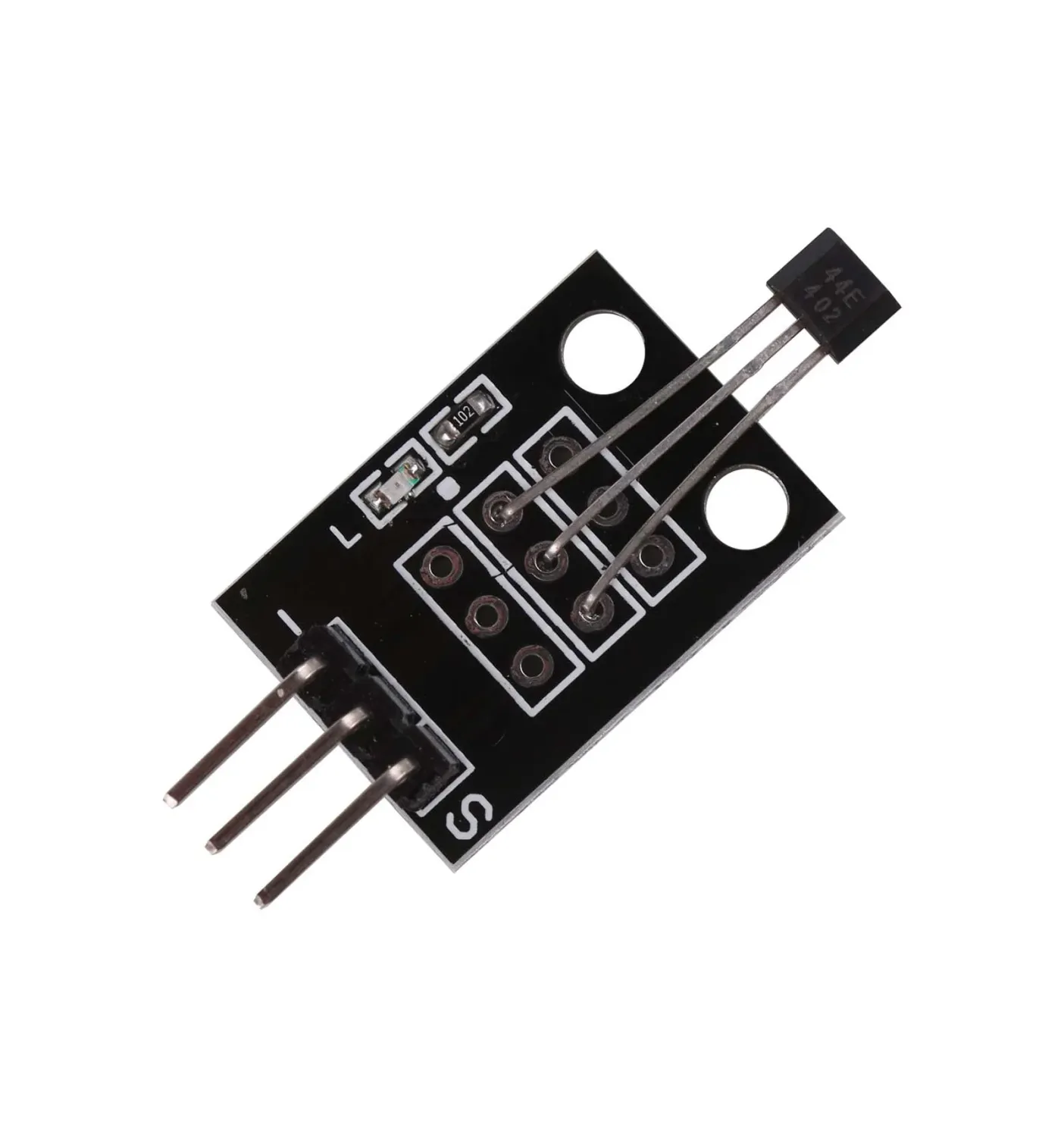
A3144 3-Pin Digital Hall Effect Sensor Module — Magnetic Field Detection for Arduino & ESP32
| Spec | Value |
|---|---|
| Sensor Type | Hall Effect IC (unipolar, magnetic field sensor) |
| Output Type | Digital (DO) only |
| Operating Voltage | 4.5V–24V DC (module regulated variants often 3.3V–5V) |
| Output Logic | LOW = south pole magnetic field detected, HIGH = no field / field removed |
| Output Stage | Open-collector NPN transistor (requires pull-up resistor, typically 10kΩ) |
| Response | Non-linear, switching-only (no analog magnitude output) |
| Package | TO-92 (bare sensor) or 3-pin breakout module |
| Interface | 3-pin (VCC, GND, DO) |
| Indicators | Digital trigger LED (on module variants) |
| Mounting | Onboard mounting hole (on module variants) |
| Compatible With | Arduino, ESP32, Raspberry Pi |
| Typical Use | Speed sensing (tachometers, RPM counters), BLDC motor commutation, door/lid proximity switches, security switches, contactless limit switches |
Handy Tips
Detects polarity, not just presence — The A3144 is a unipolar sensor: it only switches for a south pole facing the branded side of the chip. A north pole or no field leaves the output HIGH. If your magnet isn't triggering it, try flipping it before assuming the sensor is faulty.
Output logic is inverted — Like many comparator-based sensors, DO goes LOW when a magnet is detected and HIGH when idle. Write your microcontroller code or automation logic to trigger on a LOW state or falling edge, not HIGH.
Open-collector output needs a pull-up — The A3144's output stage is a bare NPN transistor to ground, not a push-pull driver. Bare sensor ICs need an external pull-up resistor (~10kΩ) to VCC to read a valid HIGH; most breakout modules already include this on-board.
No distance/strength readout — Because there's no analog output, you get on/off detection only, not a measurement of field strength or magnet distance. If you need proximity distance or intensity, look at a linear Hall sensor (e.g. A1302) instead.
Clean digital switching, GPIO-interrupt friendly — The internal Schmitt trigger gives a clean snap transition with built-in hysteresis, so the DO pin is directly suitable for GPIO interrupts without extra debouncing — useful for counting RPM pulses accurately at high speed.
Mind the trigger distance and magnet strength — Detection range depends heavily on magnet strength and orientation. For RPM/tachometer use, mount the magnet and sensor with a small, consistent air gap (a few mm) and test at your actual operating speed, since performance can degrade at very high rotational speeds if the magnet passes too briefly.
Watch supply voltage on modules — The bare IC tolerates 4.5–24V, but breakout modules with onboard LEDs/regulators may have a narrower rated range (often 3.3–5V). Check your specific module's rating before wiring to a 12V or 24V source.