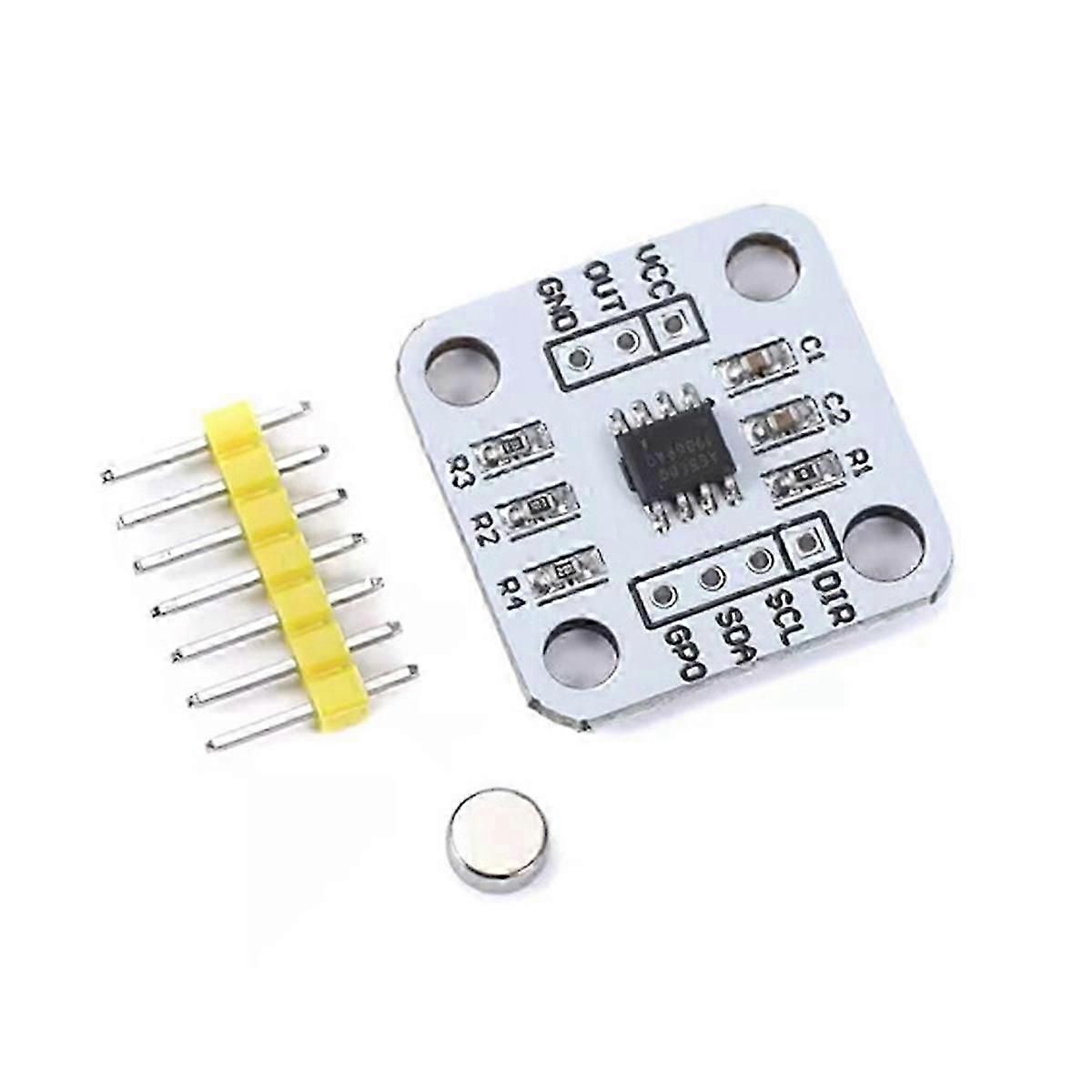
AS5600 -12-Bit High Precision Angle Sensor Module - 0-360° Coverage
Share
R65.22
Buy and save
Buy and earn R0.37 Loyalty for your next purchase
Loyalty is a discount program that lets you buy products and earn points to redeem on your next purchase. Your Loyalty balance is updated when you pay online or in-store. The Loyalty amount shown on this page can be recalculated at the checkout.
In stock
1
AS5600 -12-Bit High Precision Angle Sensor Module - 0-360° Coverage
Share
Product Details
| Spec | Value |
|---|---|
| Sensor Type | Magnetic rotary encoder IC (contactless Hall-based angle sensor) |
| Output Types | I2C (digital), PWM, Analog (ratiometric) |
| Operating Voltage | 3.3V–5V DC |
| Resolution | 12-bit (4096 positions per revolution, 0.087° resolution) |
| Measurement Range | Full 0–360° continuous rotation |
| Interface | I2C (SDA, SCL) + PWM/AO output pins, plus VCC/GND |
| Magnet Requirement | Diametrically magnetized magnet mounted on rotating shaft, centered above the IC |
| Sensing Distance | Typically 0.5–3mm air gap between magnet and sensor face |
| Programmable Settings | Start/stop angle, max angle, output stage (via onboard/OTP programming) |
| Indicators | None typically (bare breakout board) |
| Mounting | Onboard mounting holes on most breakout modules |
| Compatible With | Arduino, ESP32, Raspberry Pi, STM32 |
| Typical Use | Contactless rotary position sensing, motor shaft angle feedback, joystick/knob replacement, robotic joint angle measurement |
Handy Tips
Magnet alignment is critical — The AS5600 needs a diametrically magnetized magnet (not axially magnetized) centered directly above the die, spinning with the shaft. Off-center mounting or the wrong magnet type is the most common cause of noisy or inaccurate readings, so double-check magnet type and centering before troubleshooting code.
I2C is the most reliable output — While PWM and analog outputs are available, reading the angle over I2C (register-based, 12-bit raw value) avoids the added noise and lower resolution of PWM duty-cycle timing or ADC sampling, and gives you the full 4096-step precision directly.
Air gap matters more than you'd think — Keep the magnet-to-sensor gap within the recommended 0.5–3mm range. Too close saturates the sensor and distorts readings; too far weakens the signal and increases noise. Test at your actual final mounting gap, not just on the bench.
Watch for magnetic field interference — Nearby motors, solenoids, or ferrous metal near the sensor can distort the field the AS5600 reads. Keep other magnetic sources away from the sensor axis, especially if it's mounted near a motor it's meant to be measuring.
Zero position isn't fixed at power-on — The AS5600 doesn't inherently know "0°" unless you program a start angle or track an offset in software. Establish a reference/homing routine in your code (e.g. capture a known reference angle at startup) rather than assuming raw output always maps to a real-world zero point.
Handles continuous rotation, not just a fixed arc — Unlike a potentiometer, the AS5600 can track a full 360° continuously with no dead zone, making it well suited to things like continuously rotating knobs or motor shaft feedback — but your code needs to handle the wraparound from 4095 back to 0 correctly if you're accumulating multi-turn position.
Display prices in:ZAR