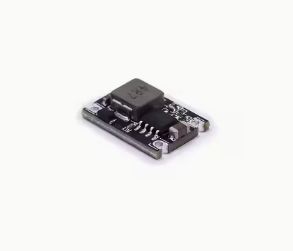
DC Voltage Regulator Step-Down Module 3A 5V/12V/24V to 3.3V Fixed Output
Share
R30.43
Buy and save
Buy and earn R0.17 Loyalty for your next purchase
Loyalty is a discount program that lets you buy products and earn points to redeem on your next purchase. Your Loyalty balance is updated when you pay online or in-store. The Loyalty amount shown on this page can be recalculated at the checkout.
In stock
1
DC Voltage Regulator Step-Down Module 3A 5V/12V/24V to 3.3V Fixed Output
Share
Product Details
DC Voltage Regulator Step-Down Module – 3A Fixed 3.3V Output – Technical Specifications:
| Module Type | – DC-DC Buck (Step-Down) Voltage Regulator |
| Input Voltage Range | – 4.8V to 24V DC |
| Output Voltage | – 3.3V Fixed |
| Output Current | – 3A Continuous |
| Output Power (Max) | – ~10W |
| Minimum Input/Output Difference | – 1.5V (Input must be at least 4.8V for stable 3.3V output) |
| Conversion Efficiency | – Up to 96% |
| Output Ripple | – ≤ 30mV (at full load) |
| Switching Frequency | – 380kHz (Typical) |
| Protection Features | – Overcurrent / Overtemperature / Short Circuit |
| Input Capacitor | – Onboard |
| Output Capacitor | – Onboard |
| Interface | – Screw Terminal or Solder Pad (IN+, IN-, OUT+, OUT-) |
| Operating Temperature | – -40°C to +85°C |
| Dimensions | – 43 × 21 × 14mm (approx.) |
| Weight | – ±8g |
Common Use Cases:
| Input Voltage | Application |
|---|---|
| 5V → 3.3V | Powering 3.3V microcontrollers and modules from a USB power bank or 5V supply |
| 12V → 3.3V | Powering ESP8266 / ESP32 / sensors directly from a 12V system or car supply |
| 24V → 3.3V | Industrial panel or solar system stepping down to logic-level supply voltage |
Handy Tips for Using the DC 3.3V Fixed Step-Down Module:
1: This module outputs a fixed 3.3V — the output voltage cannot be adjusted. It is specifically designed to supply 3.3V logic-level microcontrollers and modules such as the ESP8266, ESP32, STM32, and associated sensors and peripherals. Unlike an LDO linear regulator, this buck converter steps down voltage with very high efficiency, generating far less heat and wasting far less power in the process.
2: The input voltage must be at least 1.5V higher than the output at all times — meaning a minimum input of approximately 4.8V is required for a stable 3.3V output. A 5V USB supply will work but is right at the margin; a 6V or higher input is recommended for reliable operation. The module supports inputs up to 24V, making it suitable for 6V, 9V, 12V, and 24V supply rails.
3: The module is rated for 3A continuous output current. For loads approaching 3A, ensure adequate airflow around the module as it will generate heat at high current. For sustained loads above 2A, attaching a small heatsink to the main regulator IC is recommended to ensure long-term reliability and prevent thermal shutdown.
4: This is a switching regulator, which means it produces a small amount of high-frequency electrical noise on the output — this is normal and unavoidable. The onboard capacitors reduce this ripple to ≤30mV under load. For noise-sensitive applications such as RF modules, audio circuits, or precision ADC readings, add an additional 100µF electrolytic capacitor and a 100nF ceramic capacitor across the output terminals close to the sensitive load.
5: When wiring the module, always double-check input polarity before applying power — connecting the input in reverse will damage the module. Connect IN+ to your positive supply rail and IN- to ground, then connect OUT+ and OUT- to your load. If your board does not include reverse polarity protection, add a series Schottky diode (such as an IN5819) on the input line as a low-cost safeguard.
Display prices in:ZAR