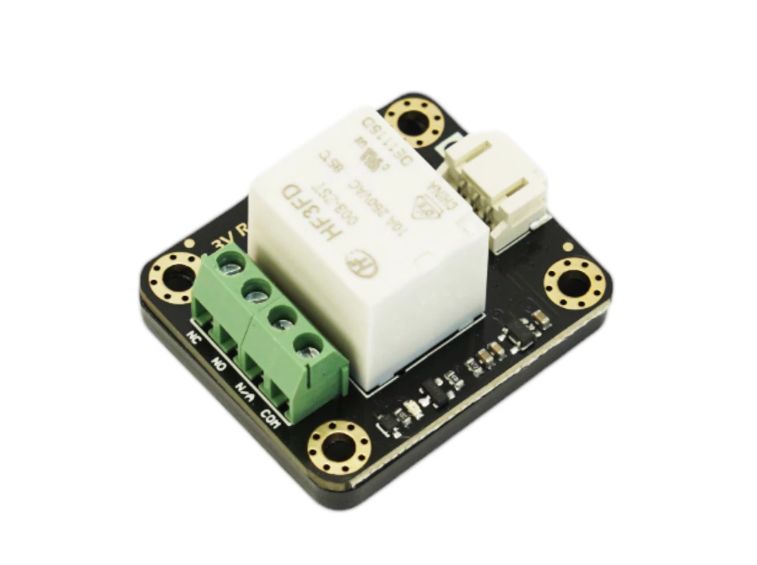
DFRobot Gravity Digital 10A Relay Module – 3.3V / 5V Compatible, Arduino & Raspberry Pi Ready
Share
R86.09
Buy and save
Buy and earn R0.49 Loyalty for your next purchase
Loyalty is a discount program that lets you buy products and earn points to redeem on your next purchase. Your Loyalty balance is updated when you pay online or in-store. The Loyalty amount shown on this page can be recalculated at the checkout.
In stock
1
DFRobot Gravity Digital 10A Relay Module – 3.3V / 5V Compatible, Arduino & Raspberry Pi Ready
Share
Product Details
Brand: DFRobot
DFRobot Gravity Digital 10A Relay Module – Technical Specifications:
| Module Type | – Single Channel Digital Relay Module |
| SKU | – DFR0473 |
| Brand | – DFRobot (Gravity Series) |
| Relay Coil Voltage | – 3V DC |
| Control Voltage Range | – 2.8V to 5.5V DC |
| Relay Rating (AC) | – 10A @ 250V AC |
| Relay Rating (DC) | – 10A @ 30V DC |
| Relay Contacts | – NO (Normally Open) + NC (Normally Closed) + COM |
| Relay Type | – SPDT (Single Pole Double Throw) |
| Trigger Type | – High-Level Trigger (HIGH = Relay ON) |
| Interface | – Gravity 3-Pin (VCC, GND, SIG) |
| Indicator LED | – Onboard Status LED (ON when Relay Activated) |
| Board Underside | – Acrylic Insulation Plate (Safety Isolation) |
| Mechanical Life | – ≥ 100,000,000 Operations |
| Operating Temperature | – -40°C to +85°C |
| Compatible Platforms | – Arduino (5V), Raspberry Pi, ESP8266, ESP32, BeagleBone Black, mbed, Intel Joule (3.3V) |
Handy Tips for Using the DFRobot Gravity Digital 10A Relay Module:
1: This module is compatible with both 3.3V and 5V devices — not only Arduino boards but also Raspberry Pi, BeagleBone Black, mbed, and other 3.3V platforms. The wide input voltage range of 2.8V to 5.5V means it works reliably across virtually all common microcontroller and single-board computer platforms without needing a logic level shifter or additional components. DFRobot
2: The Gravity 3-pin interface (VCC, GND, SIG) is plug-and-play compatible with DFRobot's Gravity connector ecosystem — simply connect the Gravity cable between the module and your controller board's digital output pin. For non-Gravity boards, connect VCC to your 3.3V or 5V supply, GND to ground, and SIG to any digital GPIO pin. In Arduino code, digitalWrite(PIN, HIGH) activates the relay and digitalWrite(PIN, LOW) deactivates it.
3: The relay contacts include both Normally Open (NO) and Normally Closed (NC) terminals. For most switching applications — turning a device ON when the relay is triggered — connect your load between COM and NO. For applications where the load should be ON by default and switch OFF when triggered, use COM and NC instead.
4: The underside of the board is isolated using an acrylic plate for safety. This is an important feature when the module is mounted inside an enclosure alongside other PCBs — it prevents accidental short circuits from the relay's solder joints contacting conductive surfaces beneath the board. Always mount the module on standoffs or ensure adequate clearance regardless.
5: The relay is rated for up to 10A current, with mechanical parts guaranteed for up to 100 million uses. However, for continuous or inductive loads such as motors, pumps, and compressors, always derate to around 6–7A maximum for long-term reliability. Inductive loads generate voltage spikes when switched off — fitting a flyback diode or snubber circuit across the load protects the relay contacts from arcing and significantly extends service life.
Display prices in:ZAR