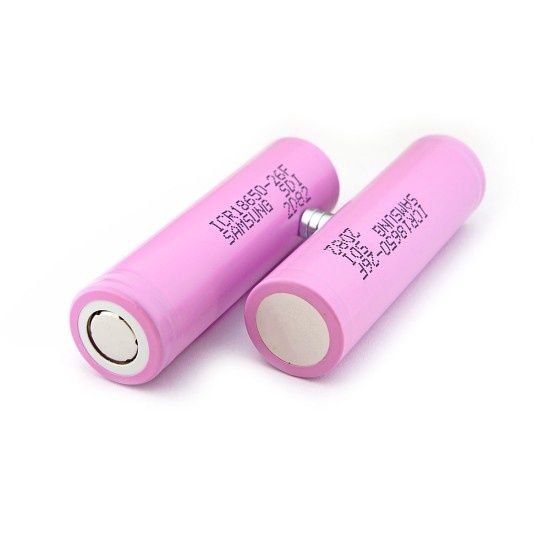
DMEGC - INR18650-26E - 3.7 2600mAh
Share
R86.09
Sold out
Sold out
DMEGC - INR18650-26E - 3.7 2600mAh
Share
Product details
Brand: DMEGC
DMEGC INR18650-26E 18650 Li-Ion Rechargeable Cell – 3.7V 2600mAh – Technical Specifications:
| Model | – INR18650-26E |
| Manufacturer | – DMEGC (Hengdian Group DMEGC Magnetics Co., Ltd.) |
| Chemistry | – Lithium-Ion (INR – Nickel Manganese Cobalt) |
| Nominal Voltage | – 3.6V / 3.7V |
| Nominal Capacity (Typical) | – 2600mAh |
| Minimum Capacity | – 2500mAh |
| Charge Voltage (Max) | – 4.20V ± 0.05V |
| Discharge Cutoff Voltage | – 2.5V |
| Standard Charge Current | – 1.3A (0.5C) CC-CV |
| Max Charge Current | – 2.6A (1C) |
| Standard Discharge Current | – 2.6A (1C) |
| Max Continuous Discharge Current | – 7.8A (3C) |
| Peak Discharge Current | – 15A (Short Duration) |
| Cycle Life | – ≥ 1,000 Cycles to 80% Capacity |
| Cell Format | – Cylindrical 18650 |
| Terminal Style | – Flat Top (Unprotected) |
| Diameter | – 18.25mm |
| Height | – 65.95mm |
| Weight | – ~47g |
| Operating Temperature (Charge) | – 0°C to +45°C |
| Operating Temperature (Discharge) | – -20°C to +60°C |
| Storage Temperature | – -20°C to +35°C (long term) |
| Certifications | – CB, IEC62133, UN38.3, MSDS |
| Applications | – DIY Battery Packs, E-Bikes, Solar Storage, Power Banks, Robotics, Portable Electronics, Power Tools |
Handy Tips for Using the DMEGC INR18650-26E Li-Ion Cell:
1: This cell is unprotected and flat top — it does not contain an internal protection circuit. When using it in DIY battery packs or portable devices, always pair it with an appropriate BMS (Battery Management System) that provides overcharge protection (cutoff at 4.2V), over-discharge protection (cutoff at 2.5V), overcurrent protection, and short circuit protection. Never use unprotected Li-Ion cells without a BMS in any application.
2: This cell has a massively high cycle life at 1,000 cycles to 80% capacity, making it a highly recommended cell for battery packs — mainly intended for electric vehicle and energy storage applications. For general DIY use such as power banks, solar storage, and robotics packs, this longevity makes it extremely cost-effective over its lifetime compared to lower-grade cells. Ic114
3: Always charge this cell with a dedicated Li-Ion charger or BMS-controlled charging circuit set to a maximum charge voltage of 4.20V. Never exceed this voltage — overcharging a Li-Ion cell causes rapid capacity degradation, heat buildup, and in worst cases, thermal runaway. The standard charge method is CC-CV (Constant Current to 4.2V, then Constant Voltage until current drops to 0.05C / ~130mA).
4: The discharge cutoff voltage is 2.5V — never discharge below this threshold. Deep discharge below 2.5V causes irreversible capacity loss and can render the cell unsafe to recharge. If storing cells long-term, maintain them at a partial charge of approximately 3.6–3.7V (around 50% state of charge) in a cool, dry place away from direct sunlight and flammable materials.
5: When building multi-cell battery packs, always use cells from the same batch with matched capacity and internal resistance. Before assembling a pack, measure the open-circuit voltage of each cell and ensure all cells are within 0.05V of each other. Mismatched cells cause uneven charging and discharging across the pack, accelerating degradation and creating safety risks — especially in series configurations.
6: ⚠️ Li-Ion Safety Warning — Li-Ion cells can cause fire or explosion if mishandled. Never short-circuit, puncture, crush, expose to water, or subject to temperatures above 60°C. Always charge on or near fireproof material and never leave charging cells unattended. Transport and store spare cells in a hard, non-conductive carrying case — never lose in a pocket, bag, or drawer alongside metallic objects.
Display prices in:ZAR