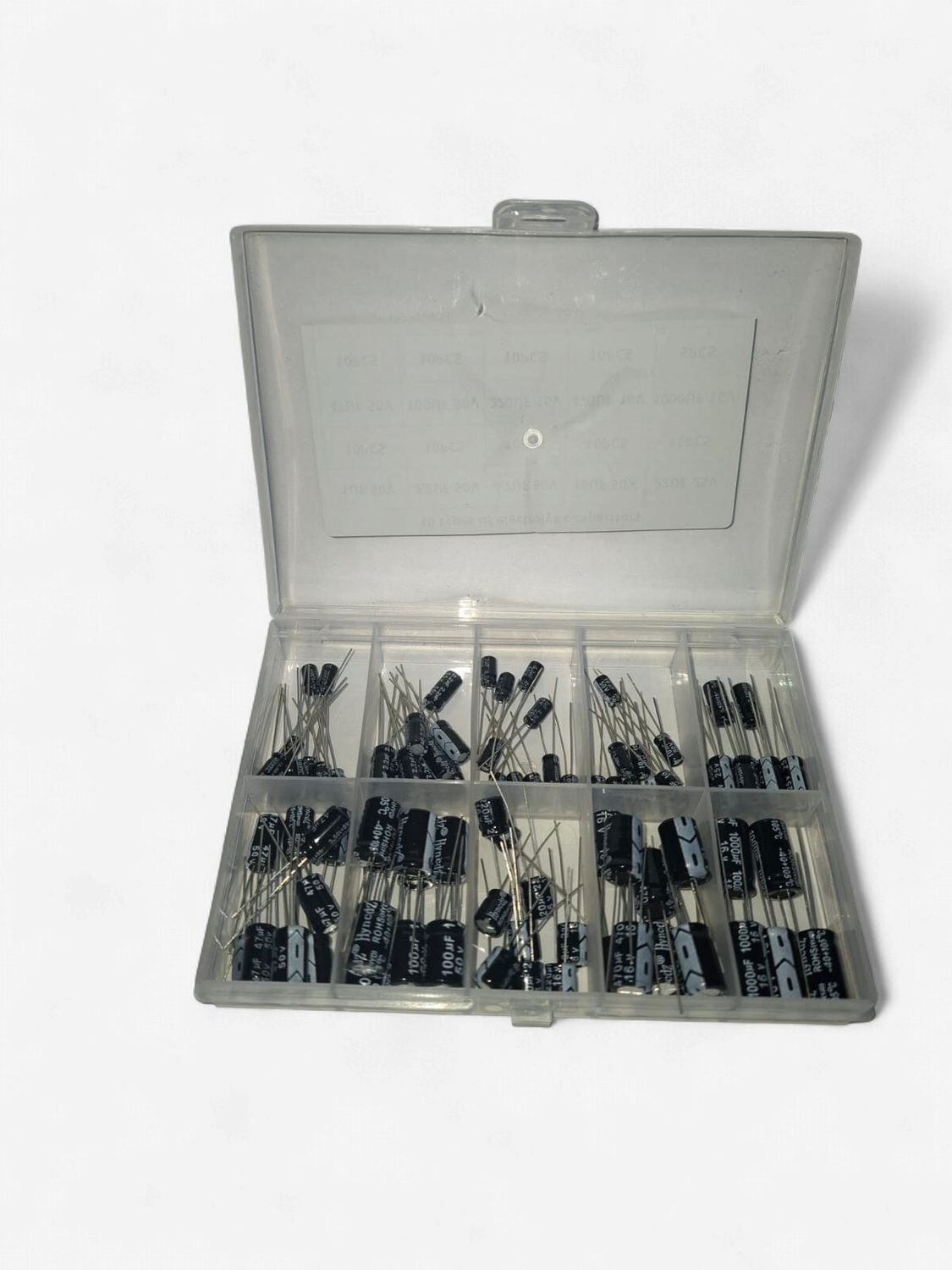
Electrolytic Capacitor Assortment Kit – 10 Values, 1µF to 1000µF, 16V / 25V / 50V
Share
R173.04
Sold out
Sold out
Electrolytic Capacitor Assortment Kit – 10 Values, 1µF to 1000µF, 16V / 25V / 50V
Share
Product details
Electrolytic Capacitor Assortment Kit – Contents:
| Capacitance | Voltage Rating | Typical Quantity |
|---|---|---|
| 1µF | 50V | 10pcs |
| 2.2µF | 50V | 10pcs |
| 4.7µF | 50V | 10pcs |
| 10µF | 50V | 10pcs |
| 22µF | 50V | 10pcs |
| 47µF | 25V | 10pcs |
| 100µF | 25V | 10pcs |
| 220µF | 25V | 10pcs |
| 470µF | 16V | 10pcs |
| 1000µF | 16V | 10pcs |
| Total | – | 100pcs |
Technical Specifications:
| Capacitor Type | – Aluminium Electrolytic (Radial, Through-Hole) |
| Value Range | – 1µF to 1000µF |
| Voltage Ratings | – 16V / 25V / 50V (value dependent) |
| Tolerance | – ±20% (M) |
| Temperature Rating | – 85°C (Standard) |
| Polarity | – Polarised (Negative Lead Marked with Stripe) |
| Lead Style | – Radial Through-Hole |
| Lead Pitch | – 2.54mm / 5.08mm (value dependent) |
| Operating Temperature | – -40°C to +85°C |
| Lifespan | – ≥ 2,000 Hours at Rated Temperature |
| Storage | – Labelled Compartment Box Included |
| Compatible Platforms | – Arduino, ESP8266, ESP32, Raspberry Pi, Breadboards, PCBs |
Handy Tips for Using the Electrolytic Capacitor Assortment Kit:
1: Electrolytic capacitors are polarised — they must be inserted with the correct orientation or they will fail, and in some cases rupture or vent. The negative leg is shorter and is also clearly indicated by a white stripe with minus (−) symbols printed along the capacitor body. The positive leg is the longer of the two. Always double-check polarity against your circuit diagram before powering up — an incorrectly inserted electrolytic is one of the most common causes of circuit failure for beginners.
2: The voltage rating must always exceed the maximum voltage the capacitor will experience in the circuit — with a comfortable safety margin of at least 20–25%. For example, in a 12V circuit use a capacitor rated at least 16V. In a 5V microcontroller circuit, a 16V rated capacitor provides adequate margin. Never use a capacitor whose voltage rating only just meets the working voltage — transient spikes can exceed the steady-state voltage and cause premature failure.
3: Electrolytic capacitors are best suited to bulk energy storage, power supply filtering, and low-frequency decoupling. Use 1000µF and 470µF caps across your power supply input and output rails to smooth rectified DC and suppress low-frequency noise. Use 100µF and 220µF caps near voltage regulators. Always pair electrolytics with a 100nF ceramic capacitor in parallel — electrolytics perform poorly at high frequencies, and the ceramic cap handles the high-frequency filtering the electrolytic cannot.
4: The capacitance value and voltage rating are printed clearly on the body — unlike resistors, there is no colour code to interpret. The value is marked directly (e.g. "100µF 25V"). If markings are worn or unclear, use a multimeter with capacitance measurement mode or a dedicated component tester to identify the value. Never guess the voltage rating of an unmarked capacitor — using an undersized voltage rating is a safety risk.
5: Electrolytic capacitors have a finite lifespan measured in operating hours at their rated temperature. Heat is the primary enemy — every 10°C above the rated temperature roughly halves the capacitor's lifespan. The capacitors in this kit are rated to 85°C, suitable for most general hobby and prototyping applications. For circuits in hot environments or high-current applications, choose 105°C rated capacitors for significantly longer service life.
6: When replacing capacitors in existing equipment — power supplies, amplifiers, or consumer electronics — always match or exceed the original capacitance value and voltage rating. Increasing the voltage rating is always safe. Slightly increasing capacitance (e.g. replacing 1000µF with 2200µF) is generally acceptable in power supply filtering but may affect timing in oscillator or timer circuits. Never substitute a lower capacitance or voltage rating than the original specification.
Display prices in:ZAR