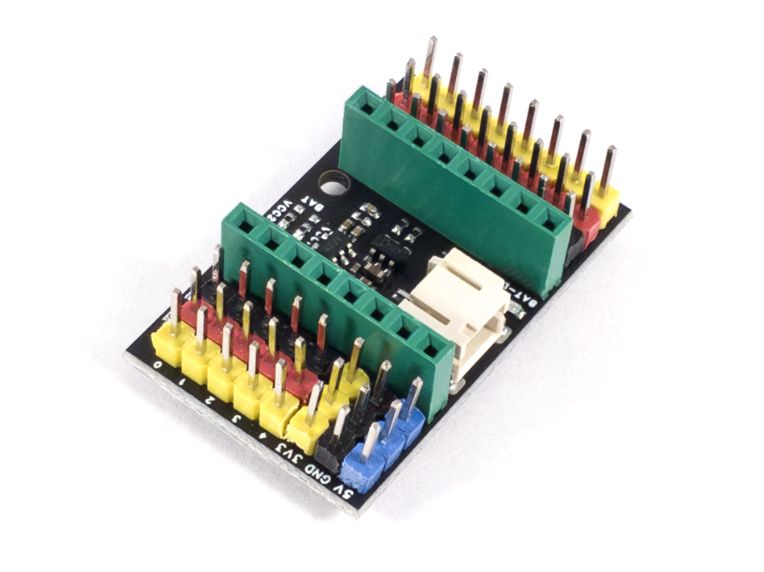
ESP32-C3 Super Mini Expansion Board – GPIO Breakout with Dual Power Rails & LiPo Battery Connector
Share
R60.00
Buy and save
Buy and earn R0.34 Loyalty for your next purchase
Loyalty is a discount program that lets you buy products and earn points to redeem on your next purchase. Your Loyalty balance is updated when you pay online or in-store. The Loyalty amount shown on this page can be recalculated at the checkout.
In stock
1
ESP32-C3 Super Mini Expansion Board – GPIO Breakout with Dual Power Rails & LiPo Battery Connector
Share
Product details
ESP32-C3 Super Mini Expansion Board – Technical Specifications:
| Compatible Board | – ESP32-C3 Super Mini (Not Included) |
| GPIO Breakout | – All ESP32-C3 Super Mini GPIO Pins Exposed |
| Pin Colour Coding | – Yellow = Signal (GPIO) / Red = VCC / Blue = GND |
| Power Rail 1 (VCC1) | – 3.3V Default (Selectable 3.7V via Solder Bridge) |
| Power Rail 2 (VCC2) | – 3.3V Default (Selectable 3.7V via Solder Bridge) |
| Battery Connector | – JST 2-Pin LiPo / Li-Ion Battery Connector (3.7V) |
| Onboard Regulator | – 3.3V LDO Voltage Regulator |
| Power Input Options | – USB-C (via ESP32-C3) or External LiPo Battery |
| Terminal Style | – 3-Pin Headers per GPIO (Signal / VCC / GND) |
| PCB Colour | – Black |
| Compatible Platforms | – Arduino IDE, MicroPython, ESPHome, PlatformIO |
Handy Tips for Using the ESP32-C3 Super Mini Expansion Board:
1: This expansion board is designed exclusively for the ESP32-C3 Super Mini — it breaks out every GPIO pin into a convenient 3-pin header format (Signal / VCC / GND), colour coded for clarity. Yellow pins = GPIO signal, Red pins = VCC power, Blue pins = GND. This makes it fast and easy to connect sensors, modules, and peripherals directly without a breadboard or additional wiring.
2: The expansion board has two independent power supplies — VCC1 and VCC2 — both defaulting to 3.3V output. When a higher voltage is needed, you can short-circuit the PCB solder bridge to change the output to 3.7V (battery voltage). VCC1 and VCC2 control their voltage outputs independently — allowing different voltage rails for different parts of your circuit if needed.
3: The onboard JST 2-pin connector accepts a standard 3.7V LiPo or Li-Ion battery, making this expansion board ideal for portable and battery-powered projects. When connecting an external power supply, you cannot use USB at the same time — USB and external power supply are mutually exclusive and only one can be used at a time. Always disconnect USB before connecting a battery.
4: The ESP32-C3 Super Mini is not included with this expansion board and must be purchased separately. When seating the ESP32-C3 Super Mini onto the expansion board, align the pin headers carefully and press down evenly — do not force the board in at an angle as this can bend the header pins or damage the GPIO contacts.
5: GPIO4 through GPIO7 on the ESP32-C3 are reserved for JTAG debugging and should be used with caution for general GPIO tasks. Avoid connecting pull-down resistors to these pins as they can interfere with the boot process. For reliable general-purpose use in your expansion board projects, prioritise GPIO0–1, GPIO3, GPIO8–GPIO10, and GPIO18–GPIO21.
Display prices in:ZAR