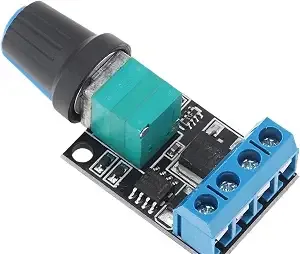
HW-070 PWM DC Motor Speed Controller / Voltage Regulator Module
Share
R42.61
Buy and save
Buy and earn R0.24 Loyalty for your next purchase
Loyalty is a discount program that lets you buy products and earn points to redeem on your next purchase. Your Loyalty balance is updated when you pay online or in-store. The Loyalty amount shown on this page can be recalculated at the checkout.
In stock
1
HW-070 PWM DC Motor Speed Controller / Voltage Regulator Module
Share
Product Details
| None typical (bare board), some variants include power LED | |
| Mounting | Mounting holes on PCB corners |
| Compatible With | DC motors, DC fans, LED strips (dimming), incandescent 12V/24V bulbs |
| Typical Use | Motor speed control, fan speed control, DC dimming, variable DC power tools |
Handy Tips
Check current rating against your actual load — The "15A" rating printed on many HW-070 boards is a peak/short-burst figure achievable only with a heatsink and forced airflow; for continuous duty, budget well under that (often 5-8A) to avoid overheating the MOSFET.
Add a heatsink for anything beyond light loads — The onboard MOSFET runs hot under sustained current, especially at lower PWM duty cycles where switching losses increase. A basic heatsink (even a small bolt-on aluminum one) meaningfully extends the module's safe operating range.
Match input voltage to your motor's rating, not just the controller's max — The board tolerating up to 90V doesn't mean your motor does. Confirm the connected motor's voltage rating first, since PWM speed control assumes a compatible voltage motor, not a step-down regulator.
Reverse polarity will likely damage it — Most HW-070 boards have no reverse-polarity protection. Double-check + and - on both the input and output screw terminals before applying power, since a wiring mistake can destroy the MOSFET instantly.
Adjust the potentiometer gradually under load — Turning the pot fully clockwise/counterclockwise at power-on with a heavy motor load can cause a large inrush current spike. Start at low PWM duty cycle and ramp up once the motor is spinning, particularly for motors with high starting torque demand.
PWM introduces electrical noise — Because it's a switching (not linear) regulator, expect some EMI/noise on the output line, which can interfere with nearby sensitive electronics (like audio circuits or precision sensors). Keep PWM wiring away from signal-sensitive cabling, and add a flyback diode across motor terminals if not already present on your motor.
Not a true "voltage regulator" in the linear sense — Despite the common product naming, this module doesn't produce a fixed clean DC output; it delivers a PWM'd voltage whose average value changes with duty cycle. For loads needing genuinely smooth/regulated DC (not just motors/resistive loads), a linear or buck regulator is more appropriate.
Display prices in:ZAR