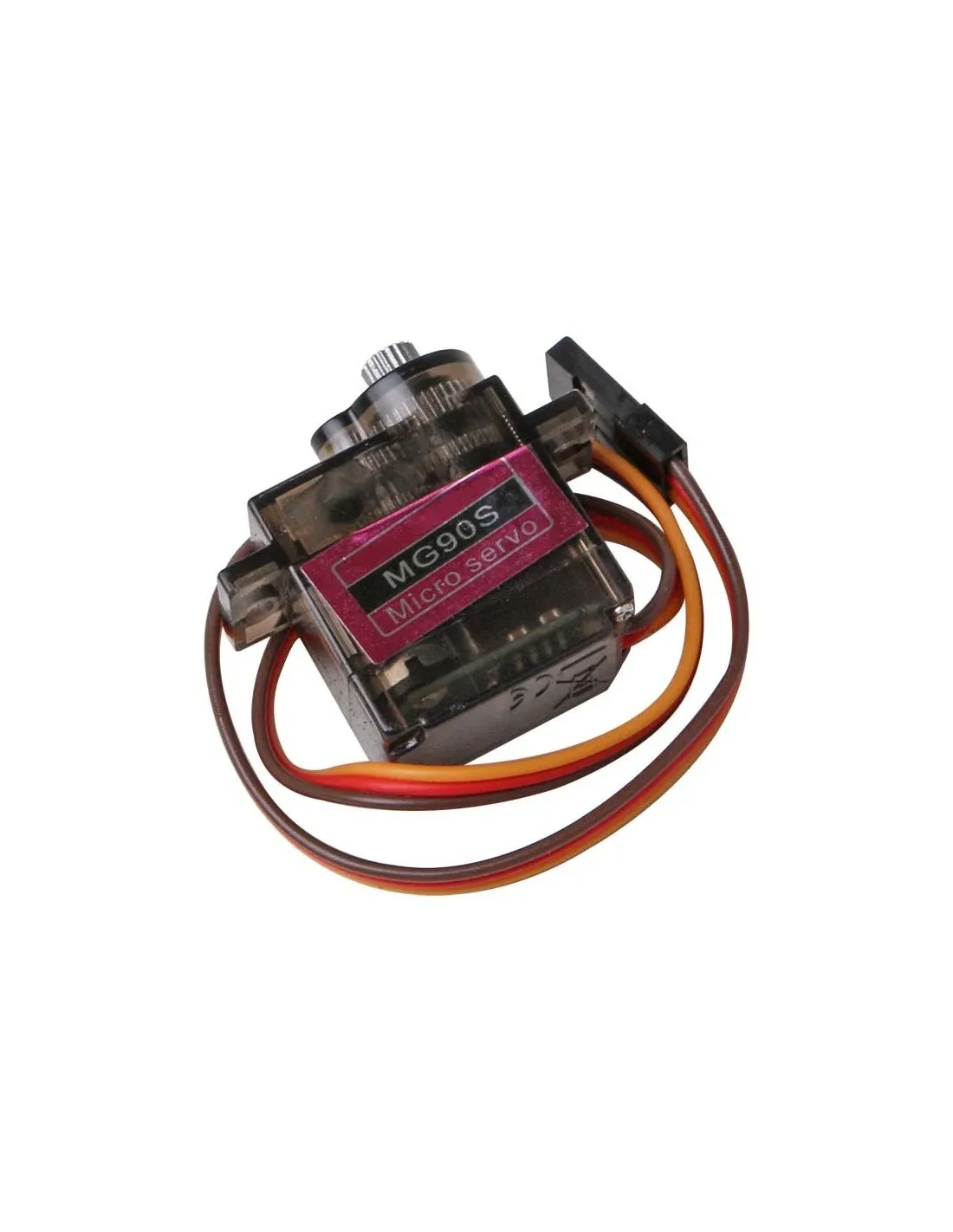
MG90S Servo Metal Gear Digital 180 Degree
Share
R51.30
Buy and save
Buy and earn R0.29 Loyalty for your next purchase
Loyalty is a discount program that lets you buy products and earn points to redeem on your next purchase. Your Loyalty balance is updated when you pay online or in-store. The Loyalty amount shown on this page can be recalculated at the checkout.
In stock
1
MG90S Servo Metal Gear Digital 180 Degree
Share
Product Details
| Spec | Value |
|---|---|
| Component Type | Digital micro servo motor, metal gear train |
| Rotation Range | 0–180° |
| Operating Voltage | 4.8V – 6V DC |
| Torque | ~1.8 kg·cm @ 4.8V, ~2.2 kg·cm @ 6V |
| Speed | ~0.1 sec/60° @ 4.8V |
| Control Signal | PWM, 50Hz, 1–2ms pulse width |
| Gear Type | All-metal gear train (upgraded from MG90's plastic/metal mix) |
| Interface / Pinout | 3-pin: Signal (orange/yellow), VCC (red), GND (brown/black) |
| Weight | ~13.4g |
| Dimensions | ~22.8 x 12.2 x 28.5mm |
| Mounting | Standard servo horn mounts (single/double arm, wheel) included |
| Compatible With | Arduino, ESP32, Raspberry Pi, RC receivers, any 5V PWM controller |
| Typical Use | RC cars/planes, robotic arms, camera pan-tilt mounts, small animatronics |
Handy Tips
Power it separately from your microcontroller — Servos draw current spikes well beyond what an Arduino's 5V regulator or a dev board's USB power can supply, especially under load or when multiple servos move at once. Use a dedicated 5-6V supply (or a buck converter off a battery) and tie the grounds together, or you'll see brownouts and erratic resets.
Center it before mounting the horn — Power the servo and send it a 1.5ms pulse (90°) before attaching the arm/horn, since MG90S units don't always start centered out of the box. Attaching the horn at the wrong position limits your usable travel range on one side.
Add a flyback/decoupling capacitor — A 100-470µF capacitor across the servo's power leads smooths out the current spikes from the motor and gearbox, reducing signal noise that can cause jitter on the PWM line, especially with longer wires.
Don't force it past its mechanical limit — Metal gears are stronger than plastic ones, but forcing the horn or sending PWM values outside ~500-2500µs can still strip the gear teeth or stall the motor; stay within the datasheet's pulse range unless you've confirmed wider travel experimentally.
Watch the stall current under load — At 4.8-6V, stall current can spike to 500mA-1A momentarily; if you're running several servos off one supply rail, budget for worst-case stall current per servo, not just the idle/no-load draw, or your supply will sag.
Check signal wire length and shielding — Long, unshielded signal wires can pick up noise from nearby motors or power lines, causing twitchy behavior. Keep signal runs short or add a series resistor (~1kΩ) near the microcontroller pin if you see jitter.
Lubricate sparingly if reused from teardown — If this is a pulled/recycled unit, a small drop of light machine oil on the gear train (not the potentiometer) can quiet grinding noises, but avoid over-oiling near the internal pot, which can cause erratic position readings.
Display prices in:ZAR