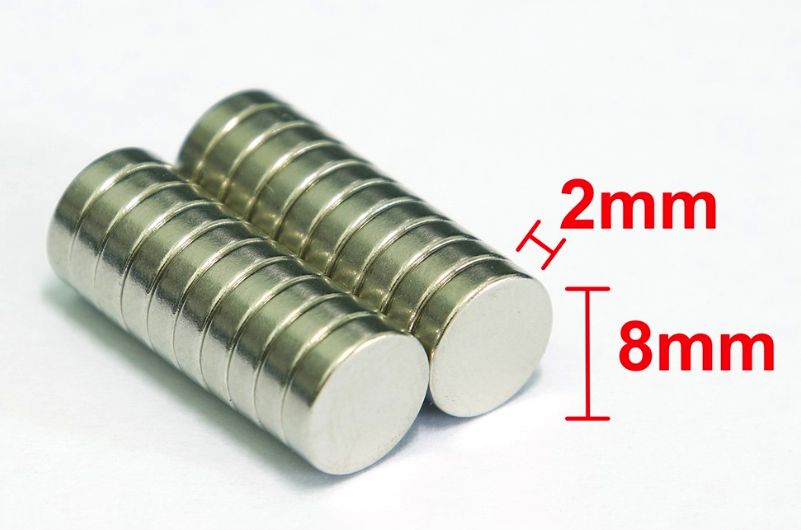
Neodymium Disc Magnets – 8mm × 2mm, N35 Heavy Duty Round - Single
Share
R3.48
Sold out
Sold out
Neodymium Disc Magnets – 8mm × 2mm, N35 Heavy Duty Round - Single
Share
Product details
8×2mm Neodymium Disc Magnet – Technical Specifications:
| Magnet Type | – Neodymium (NdFeB) Rare Earth |
| Grade | – N35 |
| Shape | – Disc (Cylinder) |
| Diameter | – 8mm |
| Thickness | – 2mm |
| Coating | – Nickel-Copper-Nickel (NiCuNi) Triple Layer |
| Magnetisation Direction | – Axial (Through Thickness) |
| Pull Force (approx.) | – ~0.8kg (7.8N) |
| Remanence (Br) | – 1.17 – 1.22 Tesla |
| Coercivity (Hcb) | – ≥ 868 kA/m |
| Maximum Operating Temperature | – 80°C |
| Quantity | – 1 Piece |
| Applications | – 3D Printing, Crafts, Sensor Mounting, Cupboard Catches, Fridge Magnets, Model Making, DIY Projects |
Handy Tips for Using the 8×2mm Neodymium Disc Magnet:
1: Despite its small size, this neodymium magnet has an approximate pull force of 0.8kg (7.8N) against a flat steel surface — significantly stronger than a ferrite or ceramic magnet of the same dimensions. This makes it ideal for applications where space is limited but holding strength matters, such as small enclosure latches, reed switch triggers, 3D printed snap-fit assemblies, and lightweight magnetic mounts.
2: This magnet is axially magnetised — the north pole is on one flat face and the south pole is on the opposite flat face. The strongest attraction and repulsion acts through the flat faces, not the edges. When embedding into a 3D printed recess or enclosure, check the orientation of the magnet relative to its mating magnet or ferrous target before gluing in place — once bonded with epoxy, reversing the orientation is not possible without damaging the part.
3: The NiCuNi (nickel) coating protects the neodymium alloy from oxidation and corrosion under normal indoor conditions. For outdoor, humid, or marine applications, seal the installed magnet with a thin layer of epoxy or silicone after installation to prevent moisture from penetrating the coating edge and causing internal corrosion over time.
4: Keep this magnet away from heat above 80°C — exceeding this temperature causes permanent and irreversible loss of magnetic strength. For 3D printing applications, always insert the magnet into the printed part after the print is complete and fully cooled. Never pause a print to insert a magnet while the hotend or heated bed are still at temperature — the proximity to heat is sufficient to partially demagnetise the magnet.
Display prices in:ZAR