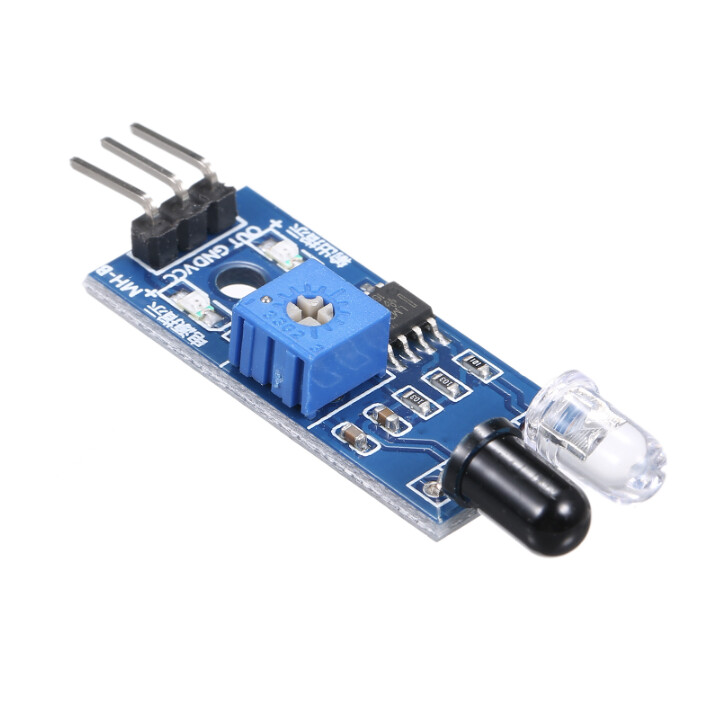
Obstacle Avoidance IR Infrared Sensor Module
R25.22
Buy and save
Buy and earn R0.14 Loyalty for your next purchase
Loyalty is a discount program that lets you buy products and earn points to redeem on your next purchase. Your Loyalty balance is updated when you pay online or in-store. The Loyalty amount shown on this page can be recalculated at the checkout.
In stock
1
Obstacle Avoidance IR Infrared Sensor Module
Product Details
Obstacle Avoidance IR Infrared Sensor Module – Technical Specifications:
| Sensor Type | – Infrared (IR) Reflective Obstacle Detection |
| Operating Voltage | – 3.3V to 5V DC |
| Operating Current | – ≤ 20mA |
| Output Type | – Digital (TTL) |
| Digital Output | – LOW = Obstacle Detected / HIGH = Clear |
| Onboard Comparator | – LM393 |
| Detection Range | – 2cm to 30cm (Adjustable) |
| Sensitivity Adjustment | – Onboard Potentiometer |
| Indicator LEDs | – Power LED (Red) + Output LED (Green) |
| IR Emitter | – 940nm Infrared LED |
| Interface | – 3-Pin Header (VCC, GND, OUT) |
| Dimensions | – 32 × 14mm |
| Operating Temperature | – -10°C to +50°C |
| Compatible Platforms | – Arduino, ESP8266, ESP32, Raspberry Pi, STM32 |
Handy Tips for Using the Obstacle Avoidance IR Infrared Sensor Module:
1: This module works by emitting an infrared beam from the IR LED and detecting whether it reflects back to the onboard IR receiver. When an object is close enough to reflect the beam, the output pin goes LOW and the green LED lights up. When no obstacle is present, the output stays HIGH. Note that this is the opposite of what many beginners expect — always account for this active-LOW behaviour in your code.
2: The onboard potentiometer adjusts the detection distance threshold. Turn it clockwise to increase the detection range (up to ~30cm) and anticlockwise to decrease it (down to ~2cm). Adjust it with a small flathead screwdriver while pointing the sensor at a test surface to dial in the exact range your project requires. Small adjustments make a big difference — turn slowly.
3: This sensor works best with solid, light-coloured, matte surfaces. Dark or black surfaces absorb infrared light instead of reflecting it, which can cause the sensor to fail to detect an obstacle even at close range. Highly reflective or shiny surfaces may trigger false positives at longer distances than expected. Always test with the actual surface materials your project will encounter.
4: The sensor is sensitive to ambient infrared light — bright sunlight and incandescent bulbs both emit significant IR radiation, which can cause false triggers or reduced detection reliability outdoors or in brightly lit environments. For outdoor use, consider shielding the sensor from direct sunlight or switching to an ultrasonic sensor (such as the HC-SR04), which is not affected by light conditions.
5: Because this module outputs a simple digital HIGH/LOW signal, it only tells you whether an obstacle is present or absent — it cannot tell you exactly how far away the obstacle is. For applications requiring actual distance measurement, pair this module with an HC-SR04 ultrasonic sensor or a Sharp GP2Y0A infrared distance sensor, which provide a proportional analogue output corresponding to distance.
Display prices in:ZAR