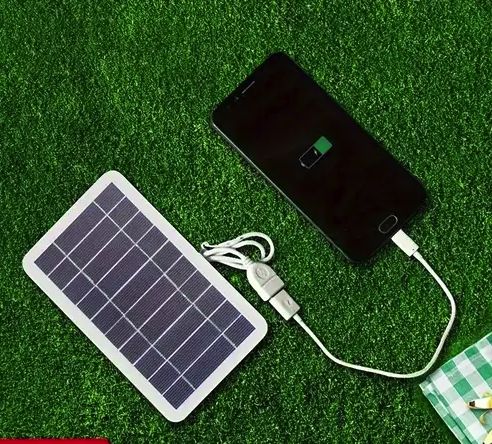
Portable Solar Charger 1pc 5V 2W
Share
R104.35
Buy and save
Buy and earn R0.60 Loyalty for your next purchase
Loyalty is a discount program that lets you buy products and earn points to redeem on your next purchase. Your Loyalty balance is updated when you pay online or in-store. The Loyalty amount shown on this page can be recalculated at the checkout.
In stock
1
Portable Solar Charger 1pc 5V 2W
Share
Product details
Portable Solar Charger Panel – 5V 2W – Technical Specifications:
| Solar Cell Type | – Monocrystalline Silicon |
| Peak Power (Pmax) | – 2W |
| Output Voltage (Voc) | – 5V DC (Open Circuit ~6V) |
| Output Current (Isc) | – 400mA (Max, Full Sun) |
| Output Connector | – USB Type-A Female |
| Conversion Efficiency | – ~18–22% (Monocrystalline) |
| Operating Temperature | – -20°C to +60°C |
| Storage Temperature | – -40°C to +80°C |
| Water Resistance | – Splash Resistant |
| Dimensions (approx.) | – 150 × 145mm |
| Weight | – ~85g |
| Quantity | – 1 Piece |
| Applications | – Phone Charging, Power Banks, Arduino / ESP32 Projects, IoT Remote Sensors, Outdoor & Camping, DIY Solar Systems |
Handy Tips for Using the 5V 2W Portable Solar Charger Panel:
1: The 2W peak output is achieved only under Standard Test Conditions (STC) — direct perpendicular sunlight at 1000W/m² irradiance and 25°C cell temperature. In real-world South African outdoor conditions, expect 60–80% of the rated output on a clear summer day. Overcast skies, early morning or late afternoon sun angles, and panel temperature above 25°C all reduce output. A panel that outputs a steady 300–350mA in good direct sunlight is performing as expected.
2: For maximum output, orient the panel perpendicular to the sun — flat on a horizontal surface is rarely optimal unless the sun is directly overhead. Tilting the panel toward the sun at the correct angle significantly increases the current output. In South Africa, facing the panel north and tilting it at an angle roughly equal to your latitude (approximately 26–34° depending on location) gives the best average daily output year-round.
3: At 400mA maximum output, this panel can trickle-charge a smartphone very slowly (most phones require 500mA–2A for meaningful charging) and is better suited to maintaining a charge on a device or topping up a small power bank over several hours of direct sun. For faster charging, consider using this panel to charge a power bank first, then charge your device from the power bank — this buffers the variable solar output into a stable, regulated charge.
4: For DIY electronics projects, pair this panel with a TP4056 charging module and a 3.7V LiPo battery to create a self-contained solar-powered system for remote Arduino, ESP8266, or ESP32 sensor nodes. The solar panel charges the LiPo during daylight, and the battery powers the project overnight or during overcast periods. Add a boost converter (MT3608) if your project needs 5V from the 3.7V battery output.
5: Keep the panel surface clean and unshaded — even partial shading of one cell in the panel can disproportionately reduce total output due to the series cell configuration. Dust, bird droppings, and fingerprints on the panel surface reduce light transmission and lower output current. Clean periodically with a soft damp cloth — avoid abrasive materials that can scratch the protective surface coating and permanently reduce efficiency.
Display prices in:ZAR