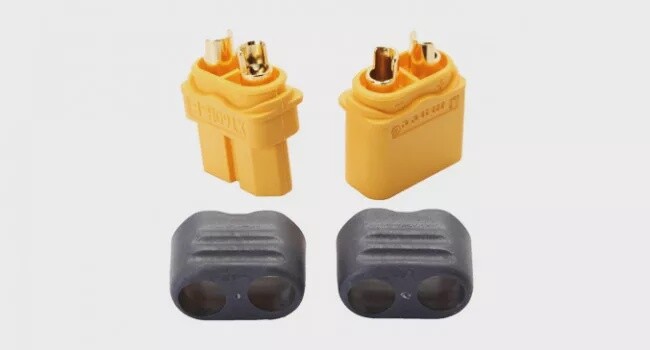
XT60 Connector Kit
R29.90
Buy and save
Buy and earn R0.17 Loyalty for your next purchase
Loyalty is a discount program that lets you buy products and earn points to redeem on your next purchase. Your Loyalty balance is updated when you pay online or in-store. The Loyalty amount shown on this page can be recalculated at the checkout.
In stock
1
XT60 Connector Kit
Product Details
Here's the description for the XT60 Connector Kit:
XT60 Connector Kit – Technical Specifications:
| Connector Type | – XT60 High-Current Power Connector |
| Gender Included | – Male (Plug) + Female (Socket) Pairs |
| Rated Current | – 60A Continuous |
| Peak Current | – 120A (Short Duration) |
| Rated Voltage | – ≤ 500V DC |
| Contact Material | – Gold-Plated Copper |
| Housing Material | – High-Temperature Nylon (PA66) |
| Wire Gauge Compatibility | – 10AWG to 14AWG (2.5mm² to 6mm²) |
| Operating Temperature | – -20°C to +120°C |
| Insulation Resistance | – ≥ 1000MΩ |
| Contact Resistance | – ≤ 0.5mΩ |
| Colour Coding | – Yellow Housing (Standard) |
| Applications | – LiPo Batteries, ESCs, RC Vehicles, eBikes, Solar Systems, DIY Power Packs |
Handy Tips for Using the XT60 Connector Kit:
1: The XT60 uses a keyed housing — the male and female connectors can only mate in one orientation, making reverse polarity connection physically impossible. By convention, the female connector (socket) is always wired to the battery or power source, and the male connector (plug) is wired to the load (ESC, inverter, charger, etc.). Following this convention ensures that no live pins are ever exposed on a disconnected battery lead.
2: XT60 connectors are designed to be soldered, not crimped. Use a soldering iron rated at least 60W — the large gold-plated copper contacts act as a heat sink and a low-powered iron will produce cold, unreliable joints. Apply flux, pre-tin both the wire and the contact cup, then feed solder into the cup while holding the wire in place. The whole process should take no more than 3–5 seconds per contact to avoid melting the nylon housing.
3: Always solder one contact at a time and allow it to cool fully before soldering the second contact. Soldering both contacts in quick succession builds up heat in the housing and can warp or melt the nylon body, misaligning the contacts and making the connector difficult or impossible to mate.
4: For high-current applications, always match your wire gauge to the current load — 10AWG wire is recommended for continuous loads approaching 60A, while 12AWG or 14AWG is adequate for lighter RC and hobby applications. Using a wire that is too thin for the load will cause resistive heating at the connector and risk fire.
5: XT60 connectors have a positive locking friction fit — they require a firm push to mate and a firm pull to separate, which prevents accidental disconnection under vibration. If your connectors feel loose or mate too easily, the contacts may be worn or the housing damaged. Replace connectors that no longer hold firmly, as a loose connection under high current causes arcing, heat, and potential fire risk.
Display prices in:ZAR